• Request Info
  • Visit
  • Apply
  • Give
  • Request Info
  • Visit
  • Apply
  • Give

Search

A-Z Index Map

Microbiology

  • About
    • Alumni and Friends
    • Annual Awards Day Ceremony
    • Facilities Resources
    • News
    • REU Program
  • People
    • Faculty
    • Affiliate Faculty
    • Staff
    • Research and Training Faculty
    • Emeritus
    • Post Doctoral
    • Current Graduate Students
    • Graduate Student Alumni
  • Research
  • Undergraduate
    • Advising
    • Courses
    • Course Offerings By Semester
    • FAQs
    • Honors in Microbiology Guidelines
    • MUC
  • Graduate
    • Assistantships
    • Course Descriptions
    • Steps to Graduation
    • Frequently Asked Questions
  • Seminars & Events
    • Seminar Series
    • Student Colloquium

UT Faculty Join New $6.5 Million Grant to Study Climate Links Between Algal Blooms and Human Health

June 3, 2024 by Logan Judy

no photo placeholder image

UT Faculty Join New $6.5 Million Grant to Study Climate Links Between Algal Blooms and Human Health

Profile

Faculty in the University of Tennessee Department of Microbiology are part of a new $6.5 million, five-year federal grant to establish a virtual center for the study of links between climate change, harmful algal blooms, and human health.

Increased precipitation, more powerful storms, and warming Great Lakes waters all encourage the proliferation of harmful algal blooms composed of cyanobacteria, also known as blue-green algae. These microorganisms can produce toxins harmful to humans, pets, and wildlife.

Though the pea-green summer blooms in western Lake Erie are the best-known in the region, cyanobacterial harmful algal blooms, or cHABs, now occur in all five Great Lakes and in fresh waters around the US. These blooms can increase water-treatment costs for local governments and harm vital summer economies in communities that enjoying fishing, swimming, and boating. In the Knoxville area earlier this year, a cHAB of Planktothrix rubescens (“pink algae”) in Meads Quarry at Ijams Nature Center closed swimming and other activity for a month.

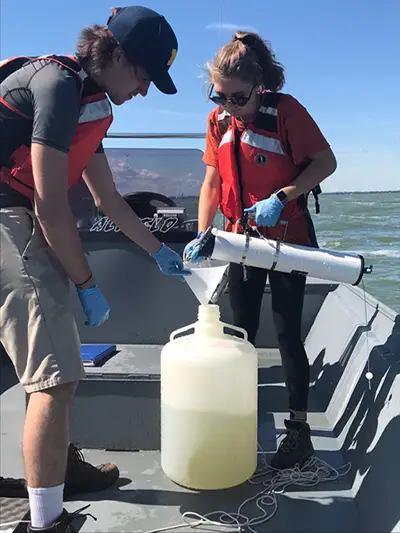
Student researchers collect water samples from a cyanobacterial harmful algal bloom in western Lake Erie as part of a project to study the effect of environmental conditions on toxin production by cyanobacteria. Photo by McKenzie Powers

“The University of Tennessee has a 25-plus year history of contributing to research on the security of our water supplies with respect to harmful algal blooms, with the Great Lakes being a major focus,” noted Steven Wilhelm, the Kenneth and Blaire Mossman Professor of Microbiology and one of the project’s leaders.

The UT team, including Wilhelm and David Talmy, assistant professor in the Department of Microbiology, will focus on the effects of a changing climate and identify new players in the biological problems the lake is having. To understand the drivers of toxic algal bloom events, they previously collaborated with researchers in Michigan and Berlin, Germany, on the development of mathematical models that predict toxin production by cells, and how some of the proposed abatement methods may have unintended consequences.

Understanding best abatement practices and projecting the long-term effects of a changing climate—as well as the disruptive storms that go with it—are a major goal of this research. Participants will work across four collective projects to enable an assessment of the human health risks of cHAB toxins. These complementary projects seek to determine how climate change affects cHABs and how cHABs impact human health.

This virtual center was founded at Bowling Green State University in 2018 with funding from the National Institutes of Health and the National Science Foundation. Following the retirement of founding director Professor George Bullerjahn at BGSU, the center’s administrative home moved to Ann Arbor with renewed funding from the two federal agencies under the directorship of University of Michigan (UM) Professor Gregory Dick.

The center maintains core projects as it evolves to pursue new directions informed by more than 70 research papers published in peer-reviewed scientific journals by center-funded scientists since 2018. In addition, center-funded researchers will develop new technologies for advanced monitoring and forecasting of cyanobacterial harmful algal blooms in collaboration with colleagues at NOAA’s Great Lakes Environmental Research laboratory and the U-M-based Cooperative Institute for Great Lakes Research.

“The threat to water resources in the Great Lakes—which hold about 95% of the surface fresh water in the US and support a multibillion-dollar blue economy—is real,” said Dick. “But despite these serious threats, key scientific questions surrounding the climate drivers and health impacts of cHABs remain unresolved. Our knowledge is not yet sufficient to predict how a changing climate will impact cHAB distributions, community composition, or toxicity.” 

Studies will combine observation, experiment, and modeling in areas of lake science, climatology, microbiology, and biomedical science. A community engagement core led by The Ohio State University (OSU) will communicate findings to relevant communities and stakeholders.

In addition to UT, UM and OSU, partners include more than 28 faculty researchers and dozens of students at Bowling Green State University, the University of Toledo, Wayne State University, Michigan State University, University of North Carolina, James Madison University, the State University of New York, and the University of Windsor in Canada.

By Randall Brown

Filed Under: Faculty, Featured, News

Fall 2023: We are Hiring!

September 19, 2023 by micro

no photo placeholder image

Fall 2023: We are Hiring!

Profile

Multiple Track and Rank Faculty Positions in Microbiology, Immunology, Plant-Microbe Interactions and Microbial Physiology!!

The Department of Microbiology at the University of Tennessee at Knoxville is seeking candidates for three tenure-track and one lecturer/lab coordinator faculty appointments.  Successful candidates are anticipated to start these positions August 1, 2024. UTK is a land-grant university and values engaged forms of research/scholarship/creative activity, teaching and service and considers evidence of these commitments in the records of applicants.

Position 1. We seek candidates at the rank of Associate or Full Professor (9-month, tenure-track) researching plant-associated microbes using molecular, genetic, biochemical, mathematical modeling and/or cell biology approaches. Specific areas of interest include, but are not limited to:

  • Plant-microbe interactions in the context of resilience in agricultural ecosystems and maintaining plant-growth promoting microbes
  • Plant-microbe-mediated resistance and mitigation of pathogens
  • Mechanistic linkage of plant-microbiome composition, function and crop growth from microscopic to regional scales
  • Tritrophic interactions among plants, microorganisms, pollinators, and/or herbivores

Full details available here: http://apply.interfolio.com/131119

Position 2. We seek candidates at the rank of Assistant Professor (9-month, tenure-track) that study host immune responses to microbes using molecular, genetic, biochemical, and/or cell biological approaches. Specific areas of interest include, but are not limited to:

  • Host responses to bacteria, fungi, protozoa (parasites), viruses, and/or helminths
  • Innate or adaptive immune responses to microbes
  • Innovative model systems for host-microbe immune focused interactions, including primary, zoonotic, and opportunistic pathogens or commensal species
  • Immune interactions at mucosal surfaces, including lungs, is of particular interest, but any niche will be considered

Full details available here: http://apply.interfolio.com/130937

Position 3. We seek candidates at the rank of Assistant Professor (9-month, tenure-track) in the area of microbial physiology. Specific areas of interest include, but are not limited to:

  • Experimental models that answer the “how” and “why” of microbial systems
  • The physiology of microorganisms including bacteria, eukaryotes, and archaea
  • The physiological effects of viral infection on microorganisms
  • Interactions of microbes with their microbiomes and environments
  • Lab model systems that resolve mechanistic links between microbes or microbiomes and their environment

Full details available here: http://apply.interfolio.com/130406

Position 4. We seek candidates for a Lecturer and Instructional Laboratory Coordinator (12-month, non-tenure track). The position is renewable yearly, contingent upon evidence of excellence in teaching and performance of programmatic duties. Principal duties involve (i) teaching an introductory microbiology course and (ii) coordinating the administration of multiple microbiology lab courses (from introductory, non-majors to upper-level majors) each semester. Responsibilities include curricular development as well as mentoring and supervision of laboratory graduate student teaching assistants (GTAs). 

Full details available here: http://apply.interfolio.com/131123

The Department of Microbiology values the quality of life of all its members and is committed to supporting the intercultural goals of the University.  Located in the foothills of the Smoky Mountains, The University of Tennessee Knoxville was founded in 1794 and is one of the oldest public universities in the nation. There are over 30,000 students enrolled at the Knoxville campus, who train and study in a city where excellence in academia meets the natural beauty of the southern Appalachian region and in the company of the artists, makers, and entrepreneurs that call Knoxville their home.

Filed Under: Featured, News

Parker Named 2020 Pew Scholar in Biomedical Sciences

August 3, 2023 by micro

no photo placeholder image

Parker Named 2020 Pew Scholar in Biomedical Sciences

Profile

Benjamin Parker, an assistant professor in the Department of Microbiology, is a member of the 2020 Pew Scholars Program in the Biomedical Sciences. Parker was selected from among 191 nominations submitted by leading US academic and research institutions to receive four years of funding to invest in exploratory research.

The 2020 Pew Scholars are undertaking groundbreaking research projects aimed at advancing human health, from development and aging to better detection, prevention, and defense against cancer.

Parker’s research uses an insect (the pea aphid) and the beneficial and harmful microbes that inhabit it as a model system to study host-microbe interactions, and his lab uses genomic, molecular, and experimental techniques.

“This work will contribute to a broader understanding of how immune systems evolve and how natural selection shapes relationships between animals and beneficial microbes,” said Parker. “It will inform more applied research exploring the effects of microbial communities on human health and disease.”

The Pew Scholars Program in the Biomedical Sciences provides funding to young investigators of outstanding promise in science relevant to the advancement of human health. The program makes grants to selected academic institutions to support the independent research of outstanding individuals who are in their first few years of their appointment at the assistant professor level.

-By Kelly Alley

Filed Under: Featured

Wilhelm Receives John H. Martin Award for Research

August 3, 2023 by micro

no photo placeholder image

Wilhelm Receives John H. Martin Award for Research

Profile

The Association for the Sciences of Limnology and Oceanography (ASLO) presents the John H. Martin Award to one paper each year that has led to fundamental shifts in research focus and interpretation of a large body of previous observations.

The 2021 John H. Martin Award is for “Viruses and nutrient cycles in the sea,” by Steven Wilhelm (University of Tennessee) and Curtis Suttle (University of British Columbia). The award will be presented at the 2021 ASLO Aquatic Sciences Virtual Meeting in June.

Wilhelm and Suttle’s foundational 1999 paper originated the concept of the ‘viral shunt,’ the phenomenon in which viral infection of marine microbes redirects flow of organic matter away from higher trophic levels and through the microbial loop. Drawing on early estimates of viral production in the water column, Wilhelm and Suttle shined a light on the considerable role viruses play in ocean biogeochemical cycles at a time when much of the research was focused on describing viral diversity and distribution. Their calculations showed that a staggering 25% of all photosynthetically fixed carbon, and associated nutrients, in the ocean may be recycled through the viral shunt.

Additionally, Wilhelm and Suttle made some of the first estimates of the total carbon stored in the viral pool and made eye-opening comparisons to the carbon stored in other types of marine organisms (including whales). Today, the concept of the viral shunt continues to influence our understanding of ocean ecosystem functioning and nutrient cycles. With >1000 citations, and more than 300 in the last five years, the legacy of “Viruses and nutrient cycles in the sea” and the viral shunt concept is still strongly felt in the field today.

“Every so often a novel concept is described which truly transforms a scientific field for decades,” says ASLO President Roxane Maranger. “Wilhelm and Suttle’s conception of the ‘viral shunt’ as a major pathway of oceanic carbon and nutrient flow in their 1999 paper is a stunning example of such a transformation.”

Full Citation: Wilhelm, S.W. and C.A. Suttle. 1999. Viruses and nutrient cycles in the sea, BioScience 49(10): 781-788. doi.org/10.2307/1313569.

ASLO is an international aquatic science society that was founded in 1948. For more than 60 years, it has been the leading professional organization for researchers and educators in the field of aquatic science. The purpose of ASLO is to foster a diverse, international scientific community that creates, integrates and communicates knowledge across the full spectrum of aquatic sciences, advances public awareness and education about aquatic resources and research, and promotes scientific stewardship of aquatic resources for the public interest. Its products and activities are directed toward these ends. With more than 3,800 members worldwide, the society has earned an outstanding reputation and is best known for its journals, interdisciplinary meetings, and special symposia. For more information about ASLO, please visit our website at www.ASLO.org.  

Filed Under: Featured, News

Mind the Gap

May 1, 2023 by micro

no photo placeholder image

Mind the Gap

Profile

Message from the Department Head
In our Spring 2022 newsletter we are proud to share with you some highlights of the exciting and important research being conducted in the Department of Microbiology here at the University of Tennessee, Knoxville. A distinguishing characteristic of academic scientists is their passion for integrating discovery with education. Scientists stand at the edge of knowledge, pushing outward toward information and ideas that can and do change the world for the better.

Throughout my career I have been inspired by the students with whom I have interacted, who are learning where that edge is, where to push, and how to be comfortable with not knowing all the answers. Often, undergraduate researchers are just beginning to realize that there even is an edge, and as educators we are metaphorically holding up signs that say “mind the gap.” Graduate student researchers know there is a gap, and have decided to commit themselves to exploring what lies within it. This is a brave decision that causes them to diverge from their peers who are starting or continuing their jobs in the ‘real world.’ For many, becoming a graduate student means daily struggles: trying to make the experiments work, trying to explain to friends and family why the results were devastating or exciting, trying to explain to a mentor why the experiment was done that way in the first place, and trying to balance the many obligations that come with being a scientist, student, educator, and a human being.

In my view, one of the greatest privileges of being a faculty member at an institution like ours is watching graduate students grow in their confidence as they realize that they are the world’s expert in the length of the gap they have chosen to study, and as they hone and expand on their ability to communicate old and new scientific ideas to anyone and everyone.

Graduate students are the linchpins of academic research. They are at the frontline of the gap, spending hours at the bench, computer, and field to wrangle large amounts of data and small amounts of liquid into something interpretable for the world. They are at the frontline of our ‘mind the gap’ campaign, helping convey in the classroom and instructional labs the results and importance of scientific discovery to hundreds of undergraduates, most of whom will not share their enthusiasm. They are at the frontline of our self-awareness and image as a department, reminding us of our obligations, both scientific and nonscientific to all members of society; reminding us often of why we are pursuing new knowledge.

Here in the department, as we start the spring semester of 2022, we have just finished interviewing students for the incoming graduate class of fall 2022. The first-year students are entering their second semester and have made the important decision of joining a lab, which will define the general area of the gap they will be exploring. The second-year students are developing and defending their project goals and approaches as they take their preliminary exam or defend their thesis. And the continuing dissertators are running ahead of their mentors, calling back as they transform the unknown into the known.  

As you read through the newsletter and gain a glimpse into the stories of some of our graduate students and faculty, I hope you will share my gratitude and awe for their choice to dedicate themselves to scientific inquiry. This choice, though difficult, makes all the difference to making sure the rest of us have solid ground beneath us. 

Heidi Goodrich-Blair
David and Sandra White Professor and Head of Microbiology

Filed Under: Featured

Jill Walton – Graduate Student Spotlight

April 15, 2023 by micro

no photo placeholder image

Jill Walton – Graduate Student Spotlight

Profile

Marie Curie once wrote “One never notices what has been done; one can only see what remains to be done.” While speaking with doctoral researcher Jill Walton, it’s clear she is the embodiment of Curie’s words. As she excitedly tells me about her studies, volunteer work, and outreach dreams, I see her vision for a more intentional use of research, academia, and scholarship to benefit not only scientific knowledge, but also humanity. 

Walton studies the roseobacter clade of marine bacteria in Alison Buchan’s lab. Roseobacter has a unique ability to degrade stable benzene rings, making it a promising candidate for the natural removal of polycyclic aromatic hydrocarbons (PAHs), which are anthropogenic pollutants composed of 2 to 6 fused benzene rings. 

Both roseobacter and PAHs — which come from oil spills, industrial discharge, wastewater, and runoff — are largely abundant in coastal environments. This mutual presence, along with roseobacter’s degradation ability, present a promising situation. 

“Roseobacter and the pollutants are there. They show the ability to degrade smaller compounds, so can they degrade more complex, structurally similar compounds?” Walton summarizes. 

Her overarching goal is to create an effective solution for PAH removal in degraded coastal environments. 

“I’m looking at roseobacter’s ability in a lab environment to degrade these pollutants to see if we can harness its ability to bioremediate these areas,” she explains. “If we know how to stimulate them, we can use what is already there instead of adding nonnative solutions.” 

Little is known about the intricacies of roseobacter’s degradation ability; however, these hurdles do not phase Walton. 

“We just need to put all the pieces together and build the story,” she enthusiastically states. 

Walton’s passion for research and solution-oriented mindset extends outside of the lab as well, resulting in an extensive list of extracurricular involvement. She regularly volunteers at the Sustainable Future Center, serves as the Microbiology Department’s Graduate Students Association Outreach and Engagement chair, and lends her voice to the Student Disability Services (SDS) Student Advisory Board. 

But her engagement does not stop here. Walton is a participant in the Community Engagement Academy offered through UT’s Access and Engagement Department where she applies her love for research to outreach initiatives. 

“We have been learning about engaged scholarship,” she explains. “We are focusing on engagement that not only benefits the community, but also our professional interests.” 

Her goal is to utilize her connection with the Sustainable Future Center to implement a community soil and water testing initiative. Walton hopes to provide free testing kits and educational workshops for community members. 

“I don’t want there to be any barriers to participation,” she elaborates. “I am really excited about it! I think it has a lot of potential to be great and an initiative other people will continue when I am no longer here.” 

Walton undoubtedly has a bright future ahead of her. Her passion for scientific discovery and her unrelinquished kindness make her invaluable to both academia and her community.

-By Taylor Mattioli

Filed Under: Featured

Buchan Elected Fellow in the American Academy of Microbiology

April 1, 2023 by micro

no photo placeholder image

Buchan Elected Fellow in the American Academy of Microbiology

Profile

Alison Buchan, Carolyn W. Fite Professor and associate head of microbiology at the University of Tennessee, Knoxville, was recently elected as a 2022 Fellow in the American Academy of Microbiology. This is an honor that recognizes service, leadership, and creative achievement in the field of  microbiology.  

The fellow selection process is based on several factors, such as scientific and innovative achievements. This year, only 65 professors from across the world received the honor.

“I am humbled and honored to join the ranks of the American Academy of Microbiologists,” Buchan said. ”I am grateful to my many past and current mentors, supporters, and also the many talented and inspiring undergraduate and graduate students that I have had the unique privilege to work with over the years.”

Buchan’s expertise in her discipline has a broad scope. She is a microbial ecologist who studies the interactions bacteria have with one another and more recently she is studying the viruses that infect them. She is also trained as a microbiologist (MSc) and a marine scientist (PhD). The multidisciplinary research Buchan has accomplished at UT has given her the opportunity to collaborate with several other scientists such as chemists, geochemists, and modelers.  

“Science is most definitely a team effort and I am so fortunate to have had the opportunity to work with fabulous students, faculty and research staff here at UT.”

Filed Under: Featured

  • « Previous Page
  • 1
  • 2
  • 3

Recent Posts

  • Scholar Spotlight: Sara J. Clasen
  • Wilhelm Named Distinguished Professor
  • Steven Wilhelm in ‘The Conversation:’ Viruses aren’t all bad: In the ocean, some help fuel the food web – a new study shows how
  • Graduate Student Sarina Mitchell Wins Smokey’s Choice Award
  • NIH Grant Supports UT Research on Chronic Wounds

Recent Comments

No comments to show.

College of Arts & Sciences

117 Natalie L. Haslam Music Center
1741 Volunteer Blvd.
Knoxville TN 37996-2600

Phone: 865-974-3241

Archives

  • August 2026
  • July 2026
  • January 2026
  • December 2025
  • November 2025
  • September 2025
  • August 2025
  • June 2025
  • April 2025
  • February 2025
  • January 2025
  • December 2024
  • August 2024
  • July 2024
  • June 2024
  • April 2024
  • March 2024
  • September 2023
  • August 2023
  • May 2023
  • April 2023
  • March 2023
  • February 2023
  • January 2023
  • July 2022
  • January 2020

Categories

  • Faculty
  • Featured
  • News
  • Newsletter
  • Uncategorized

Copyright © 2026 · University of Tennessee, Knoxville WDS Genesis Child on Genesis Framework · WordPress · Log in

Department of Microbiology

College of Arts and Sciences

1311 Cumberland Avenue
307 Ken and Blaire Mossman Bldg.
Knoxville TN 37996-1937

Email: microbiology@utk.edu

Phone: 865-974-3441

The University of Tennessee, Knoxville
Knoxville, Tennessee 37996
865-974-1000

The flagship campus of the University of Tennessee System and partner in the Tennessee Transfer Pathway.

ADA Privacy Safety Title IX