UT’s Rising Stars of Microbiology

Mitochondria have primarily been known as the energy-producing components of cells. But scientists are increasingly discovering that these small organelles do much more than just power cells. They are also involved in immune functions such as controlling inflammation, regulating cell death and responding to infections.
Research from my colleagues and I revealed that mitochondria play another key role in your immune response: sensing bacterial activity and helping neutrophils, a type of white blood cell, trap and kill them.
For the past 16 years, my research has focused on understanding the decisions immune cells make during infection and how the breakdown of these decision-making processes cause disease. My lab’s recent findings shed light on why people with autoimmune diseases such as lupus may struggle to fight infections, revealing a potential link between dysfunctional mitochondria and weakened immune defenses.

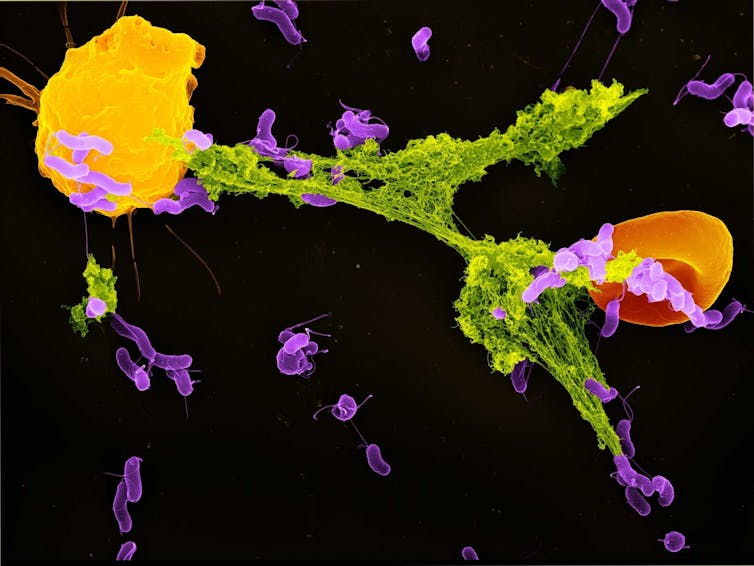
Neutrophils are the most abundant type of immune cell and serve as the immune system’s first responders. One of their key defense mechanisms is releasing neutrophil extracellular traps, or NETs – weblike structures composed of DNA and antimicrobial proteins. These sticky NETs trap and neutralize invading microbes, preventing their spread in the body.
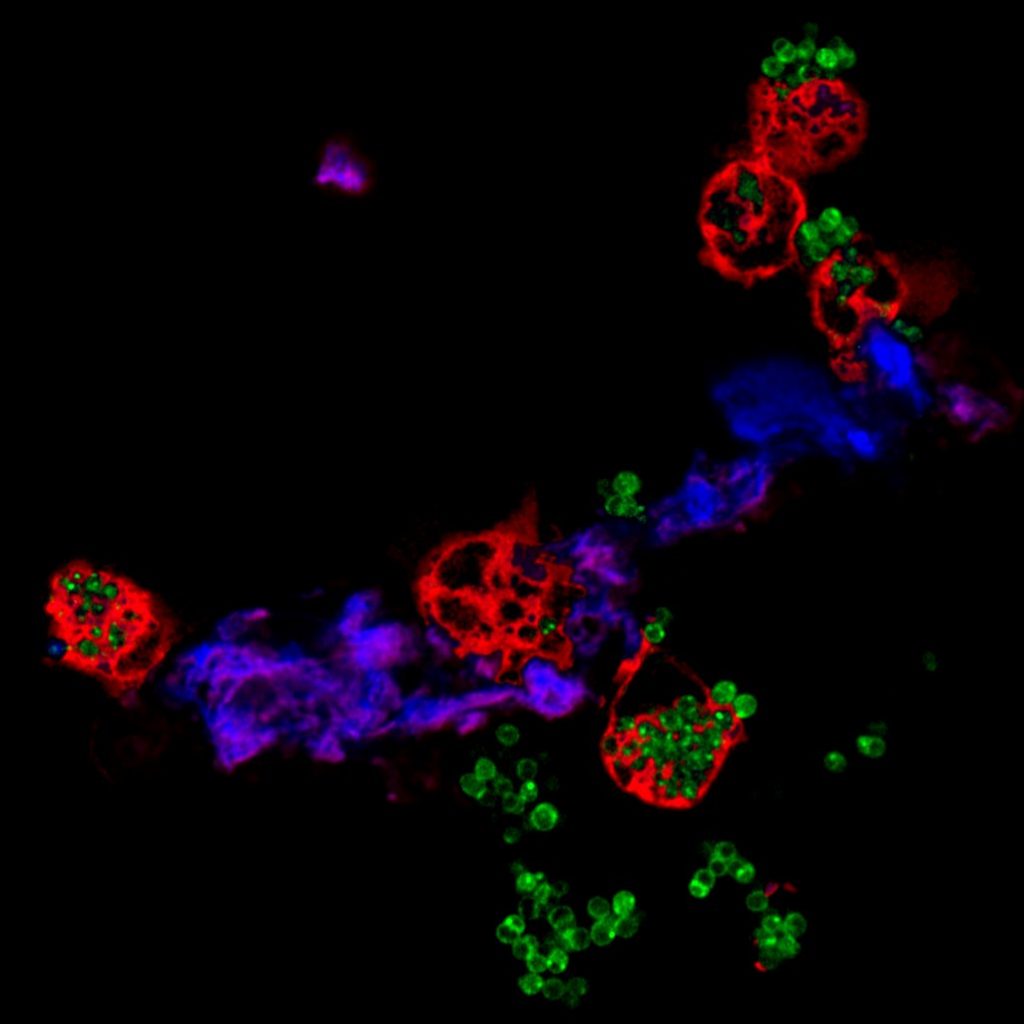
Until recently, scientists believed that NET formation was primarily triggered by cellular stress and damage. However, our study found that mitochondria can detect a specific bacterial byproduct – lactate – and use that signal to initiate NET formation.
Lactate is commonly associated with muscle fatigue in people. But in the context of bacterial infections, it plays a different role. Many bacteria release lactate as part of their own energy production. My team found that once bacteria are engulfed by a compartment of the cell called the phagosome, neutrophils can sense the presence of this lactate.
Inside the phagosome, this lactate communicates to the neutrophil that bacteria are present and that the antibacterial processes are not sufficient to kill these pathogens. When the mitochondria in neutrophil cells detect this lactate, they start signaling for the cell to get rid of the NETs that have entrapped bacteria. Once the bacteria are released outside the cell, other immune cells can kill them.
When we blocked the mitochondria’s ability to sense lactate, neutrophils failed to produce NETs effectively. This meant bacteria were more likely to escape capture and proliferate, showing how crucial this mechanism is to immune defense. This process highlights an intricate dialogue between the bacteria’s metabolism and the host cell’s energy machinery.
What makes this finding surprising is that the mitochondria within cells are able to detect bacteria trapped in phagosomes, even though the microbes are enclosed in a separate space. Somehow, mitochondrial sensors can pick up cues from within these compartments – an impressive feat of cellular coordination.
Our study is part of a growing field called immunometabolism, which explores how metabolism and immune function are deeply intertwined. Rather than viewing cellular metabolism as strictly a means to generate energy, researchers are now recognizing it as a central driver of immune decisions.
Mitochondria sit at the heart of this interaction. Their ability to sense, respond to and even shape the metabolic environment of a cell gives them a critical role in determining how and when immune responses are deployed.
For example, our findings provide a key reason why patients with a chronic autoimmune disease called systemic lupus erythematosus often suffer from recurrent infections. Mitochondria in the neutrophils of lupus patients fail to sense bacterial lactate properly. As a result, NET production was significantly reduced. This mitochondrial dysfunction could explain why lupus patients are more vulnerable to bacterial infections – even though their immune systems are constantly activated due to the disease.
This observation points to mitochondria’s central role in balancing immune responses. It connects two seemingly unrelated issues: immune overactivity, as seen in lupus, and immune weakness like increased susceptibility to infection. When mitochondria work correctly, they help neutrophils mount an effective, targeted attack on bacteria. But when mitochondria are impaired, this system breaks down.

Our discovery that mitochondria can sense bacterial lactate to trigger NET formation opens up new possibilities for treating infections. For instance, drugs that enhance mitochondrial sensing could boost NET production in people with weakened immune systems. On the flip side, for conditions where NETs contribute to tissue damage – such as in severe COVID-19 or autoimmune diseases – it might be beneficial to limit this response.
Additionally, our study raises the question of whether other immune cells use similar mechanisms to sense microbial metabolites, and whether other bacterial byproducts might serve as immune signals. Understanding these pathways in more detail could lead to new treatments that modulate immune responses more precisely, reducing collateral damage while preserving antimicrobial defenses.
Mitochondria are not just the powerhouses of the cell – they are the immune system’s watchtowers, alert to even the faintest metabolic signals of bacterial invaders. As researchers’ understanding of their roles expands, so too does our appreciation for the complexity – and adaptability – of our cellular defenses.
Andrew Monteith, Assistant Professor of Microbiology, University of Tennessee
This article is republished from The Conversation under a Creative Commons license. Read the original article.
A nearly $1.86 million National Institutes of Health grant will allow Andrew Monteith to further study how metabolic processes affect the ways certain white blood cells fight pathogens.
The Maximizing Investigators’ Research Award (MIRA) is the first to Monteith, an assistant professor since January 2023 in the Department of Microbiology with a joint appointment to the Department of Biochemistry and Cellular and Molecular Biology.
Monteith’s work centers on neutrophils, the backbone of the innate immune response to infection. Although they possess an arsenal of antimicrobial processes to combat invading pathogens, neutrophils also cause inflammation, requiring a delicate balance to limit tissue damage while clearing pathogens.
“The goal of this proposal is to decipher how metabolic processes feed into regulating neutrophil function (immunometabolism) and to understand how comorbidities like diabetes, obesity, and autoimmune disease render neutrophils less effective at combating infection,” said Monteith.
His previous work showed mitochondria within neutrophils dictate whether they release neutrophil extracellular traps (NETs) in response to bacteria. NETosis is the release of a meshwork of the neutrophil’s chromosomal DNA studded with antimicrobial proteins to entrap and kill pathogens, he explained.
Mitochondria are typically seen as the “powerhouse of the cell,” but neutrophils derive nearly all their energy from other metabolic processes. Monteith proposes that mitochondria in neutrophils evolved to detect metabolic changes and dictate how neutrophils should respond during infection.
His research program will use cutting-edge technologies like chimeric immune cell editing (CHIME) to link the pathways that dictate how the neutrophils decide when to cast NETs and how diseases like diabetes and lupus interfere with these signals, causing aberrant inflammation.
The MIRA funding extends through June 2029. “I hope my research program can evolve into other areas of neutrophil immunometabolism, including understanding how diabetes, obesity, and autoimmune diseases impact neutrophil formation in the bone marrow (hematopoiesis), neutrophil persistence within tissues and at the sites of infection, and other inflammatory processes,” said Monteith.
Staff in the College of Arts and Sciences’ Office of Research and Creative Activity helped Monteith with the application budget and other documents before and after his proposal was scored.
Monteith’s interest in immune cells began in middle school, when his mother was diagnosed with multiple sclerosis, an autoimmune disease.
“As I progressed through my undergraduate, graduate, and postdoctoral training, I was fascinated by how each immune cell played a very specific role and how they worked together to perform a functional immune response,” he said. “Better than 99 percent of the time, the immune response does its job, but occasionally something breaks and disease happens. I was most interested in understanding the mechanisms of these negative outcomes and strategies to swing the battle back in favor of the immune response.”
by Amy Beth Miller
With a $1.82 million National Institutes of Health grant, Assistant Professor Lindsey Burcham is leading interdisciplinary research on the vaginal microbiome, which can affect maternal, fetal, and pediatric health.
“We are incorporating techniques in microbial genetics/molecular biology, analytical chemistry, and in vitro and in vivo models to learn more about how microbes persist in the vaginal mucosa,” Burcham explained.
“This work will allow us to learn more about the availability of micronutrients in the vaginal tract and understand how vaginal microbes sense nutrient availability, respond to nutrient fluctuations, and share these nutrients within the community,” she said.
The five-year Maximizing Investigators’ Research Award (MIRA) began in 2023 and will run until June 2028.
Burcham also is using computer simulations, or in silico models, in collaboration with UT microbiology Assistant Professor Zach Burcham to predict metabolite exchange between vaginal microbes.
“These models allow us to develop testable hypotheses to understand more about how microbes may interact with each other and behave in the host,” Lindsey Burcham said.
The researchers also will use synthetic communities, or controlled co-cultures of microbes, to study microbial interactions and to understand how individual microbes may impact the overall function of the microbial community.
The MIRA funding provides flexibility for investigators to be creative and work toward big-picture questions, Lindsey Burcham said. “The work outlined here will set the foundation for understanding more about the vaginal environment and microbe-microbe interactions, but I envision this is a starting point. We have already started some exciting new projects investigating other environmental factors within the vaginal tract, and we will go where the data take us.”
She has helped to assemble a collaborative “bench-to-bedside” research team including Zach Burcham and physicians Kim Fortner, Callie Reeder, and Logan Riley, as well as Associate Professor Jill Maples from the University of Tennessee Medical Center’s Department of Obstetrics and Gynecology.
Lindsey Burcham has been curious about microbes and motivated to understand how they work since she was an undergraduate student, and her personal life influenced her research interests.
“My own pregnancies fueled my curiosity for understanding the vaginal tract and the impact of microbes on vaginal health,” she said. “Now as the leader of a research team, I am excited to be able to use my lab and resources to promote women’s health research and to normalize the discussion around vaginal health.”
