• Request Info
  • Visit
  • Apply
  • Give
  • Request Info
  • Visit
  • Apply
  • Give

Search

A-Z Index Map

Microbiology

  • About
    • Alumni and Friends
    • Annual Awards Day Ceremony
    • Facilities Resources
    • News
    • REU Program
  • People
    • Faculty
    • Affiliate Faculty
    • Staff
    • Research and Training Faculty
    • Emeritus
    • Post Doctoral
    • Current Graduate Students
    • Graduate Student Alumni
  • Research
  • Undergraduate
    • Advising
    • Courses
    • Course Offerings By Semester
    • FAQs
    • Honors in Microbiology Guidelines
    • MUC
  • Graduate
    • Assistantships
    • Course Descriptions
    • Steps to Graduation
    • Frequently Asked Questions
  • Seminars & Events
    • Seminar Series
    • Student Colloquium

Zepernick Investigates How Freshwater Diatoms Stay in the Light

March 13, 2024 by Logan Judy

no photo placeholder image

Zepernick Investigates How Freshwater Diatoms Stay in the Light

Profile

Spring weather brings welcome conditions for flowers and plant life to bloom across the land. The right mixture of temperature, moisture, and light helps keep the green world vibrant.

Underwater plant life generally responds to similar environmental encouragements, but a curious discovery in Lake Erie circa 2012 led microbiologists to study an unseasonal display of winter abundance. Blooms of diatoms—microscopic, photosynthetic algae—were alive and well beneath (and within) the lake’s ice cover.

“Some of the main winter-spring diatom bloom formers, like Aulacoseira islandica, have a symbiotic relationship with heterotrophic bacteria capable of forming tiny ice crystals, which over time causes the diatom filaments to become buoyant—just as ice cubes float in your favorite beverage,” said Brittany Zepernick, a post-doctoral researcher and SEC Emerging Scholar in UT’s Department of Microbiology.

These ‘diatom ice cubes’ float to the Lake Erie ice cover and embed within it, putting them in position to absorb the light needed to perform photosynthesis throughout the winter months. It was good news for diatoms, which are a vital component of the cumulative ecosystem in lakes and oceans across the globe

This curious adaptation is threatened, though, as warming global temperatures have led to widespread ice decline across the Great Lakes, leaving Lake Erie in a nearly ice-free state in several recent winters and leaving diatoms stuck in murky, light-deprived waters. In these new “climatically uncharted waters,” the adaptations that benefitted these winter diatoms for so long suddenly ceased to serve them.

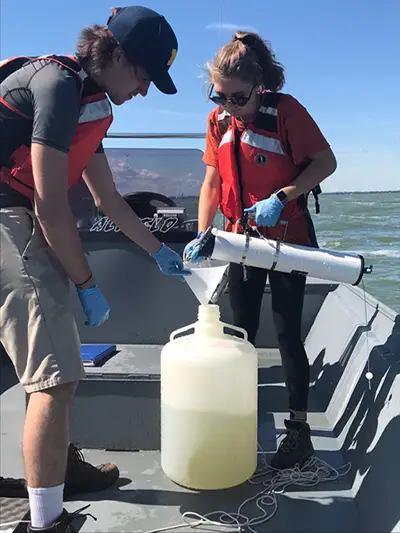
So, what’s a diatom to do? Zepernick and colleagues turned to the shores of Lake Erie to investigate the evolving situation. With the help of the US and Canadian Coast Guard, they sampled the ice-covered (in 2019) and ice-free (in 2020) winter waters of Lake Erie to learn how diatoms were responding to changing environmental conditions. They recently published their work in the ISME Journal—Multidisciplinary Journal of Microbial Ecology.

Two main diatom genera dominate the winter blooms: Aulacoseira islandica and Stephanodiscus spp.

“The abundance of Stephanodiscus spp. was approximately 70 percent lower in the ice-free water column of 2020 compared to the ice-covered water column of 2019,” said Zepernick. “Likewise, the abundance of Aulacoseira islandica was around 50 percent lower in the ice-free water column compared to the ice-covered water column.”

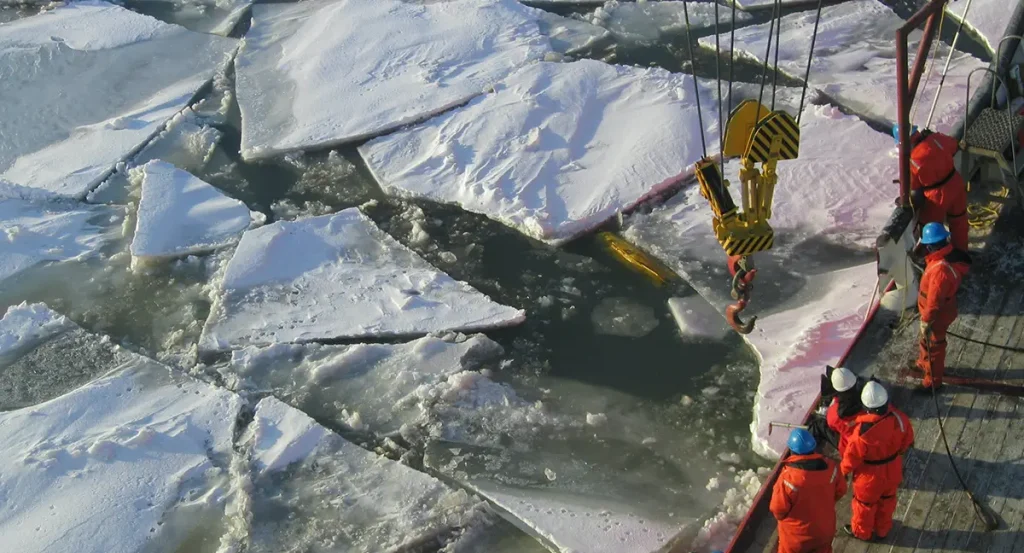
Ice floating on the surface of Lake Erie
Diatoms adapted to embed in Lake Erie’s ice cover—can they adapt to stay afloat without ice?

With ice cover across the Great Lakes at record lows—from around 80 percent covered in ice in 2018 and 2019 to just 8 percent covered in 2023—researchers expect this trend will continue in future winters. 

The next step is studying how this impacts Lake Erie, which joins the other Laurentian Great Lakes of the US and Canada to cumulatively contain approximately 20 percent of the globe’s fresh water.

“Despite the critical importance of this system, we didn’t know diatom blooms even formed in the winter-spring months until around 2012,” said Zepernick. “Many researchers have referred to the winter water column as a ‘New Frontier’ or a ‘black box.’ What we do know is that diatoms are critically important to regional lake ecosystems and global climate.”

Diatoms make up an estimated 20 percent of global carbon sequestration and oxygen production, play an enhanced role in global biogeochemical cycles, and represent a critical component of the aquatic ecosystem in freshwater systems.

“Hence, the large-scale changes already underway to the winter-spring diatom communities in Lake Erie and other lakes across the globe will result in large-scale biological and biogeochemical change,” said Zepernick.

The light at the end of the icy tunnel could rely on the diatoms’ potential to adapt. Zepernick’s recent work indicates they could possibly form clusters with adhesive proteins called fasciclins to “raft” to the surface of the muddy waters via “underwater waves” produced by wind, convection, and underwater currents.

Another adaptation Zepernick hinted at was that diatoms could increase their use of proton-pumping rhodopins (PPRs)—light harvesting, retinal-containing proteins that could serve as an alternative to classical photosynthesis. She is currently attempting to isolate freshwater diatoms from Lake Erie samples that possess PPRs to create a model freshwater diatom-PPR system for further study. Her findings could offer clues to the diatoms’ next move in a rapidly changing climate.

“PPRs are a hot topic within marine literature, yet we know very little about how these mechanisms apply to freshwater systems and taxa,” she said. “I am interested in elucidating the benefits PPRs may confer to both freshwater and marine diatoms across a variety of emerging—and future—climatic stressors.”

Filed Under: Faculty, News

Fall 2023: We are Hiring!

September 19, 2023 by micro

no photo placeholder image

Fall 2023: We are Hiring!

Profile

Multiple Track and Rank Faculty Positions in Microbiology, Immunology, Plant-Microbe Interactions and Microbial Physiology!!

The Department of Microbiology at the University of Tennessee at Knoxville is seeking candidates for three tenure-track and one lecturer/lab coordinator faculty appointments.  Successful candidates are anticipated to start these positions August 1, 2024. UTK is a land-grant university and values engaged forms of research/scholarship/creative activity, teaching and service and considers evidence of these commitments in the records of applicants.

Position 1. We seek candidates at the rank of Associate or Full Professor (9-month, tenure-track) researching plant-associated microbes using molecular, genetic, biochemical, mathematical modeling and/or cell biology approaches. Specific areas of interest include, but are not limited to:

  • Plant-microbe interactions in the context of resilience in agricultural ecosystems and maintaining plant-growth promoting microbes
  • Plant-microbe-mediated resistance and mitigation of pathogens
  • Mechanistic linkage of plant-microbiome composition, function and crop growth from microscopic to regional scales
  • Tritrophic interactions among plants, microorganisms, pollinators, and/or herbivores

Full details available here: http://apply.interfolio.com/131119

Position 2. We seek candidates at the rank of Assistant Professor (9-month, tenure-track) that study host immune responses to microbes using molecular, genetic, biochemical, and/or cell biological approaches. Specific areas of interest include, but are not limited to:

  • Host responses to bacteria, fungi, protozoa (parasites), viruses, and/or helminths
  • Innate or adaptive immune responses to microbes
  • Innovative model systems for host-microbe immune focused interactions, including primary, zoonotic, and opportunistic pathogens or commensal species
  • Immune interactions at mucosal surfaces, including lungs, is of particular interest, but any niche will be considered

Full details available here: http://apply.interfolio.com/130937

Position 3. We seek candidates at the rank of Assistant Professor (9-month, tenure-track) in the area of microbial physiology. Specific areas of interest include, but are not limited to:

  • Experimental models that answer the “how” and “why” of microbial systems
  • The physiology of microorganisms including bacteria, eukaryotes, and archaea
  • The physiological effects of viral infection on microorganisms
  • Interactions of microbes with their microbiomes and environments
  • Lab model systems that resolve mechanistic links between microbes or microbiomes and their environment

Full details available here: http://apply.interfolio.com/130406

Position 4. We seek candidates for a Lecturer and Instructional Laboratory Coordinator (12-month, non-tenure track). The position is renewable yearly, contingent upon evidence of excellence in teaching and performance of programmatic duties. Principal duties involve (i) teaching an introductory microbiology course and (ii) coordinating the administration of multiple microbiology lab courses (from introductory, non-majors to upper-level majors) each semester. Responsibilities include curricular development as well as mentoring and supervision of laboratory graduate student teaching assistants (GTAs). 

Full details available here: http://apply.interfolio.com/131123

The Department of Microbiology values the quality of life of all its members and is committed to supporting the intercultural goals of the University.  Located in the foothills of the Smoky Mountains, The University of Tennessee Knoxville was founded in 1794 and is one of the oldest public universities in the nation. There are over 30,000 students enrolled at the Knoxville campus, who train and study in a city where excellence in academia meets the natural beauty of the southern Appalachian region and in the company of the artists, makers, and entrepreneurs that call Knoxville their home.

Filed Under: Featured, News

Wilhelm Receives John H. Martin Award for Research

August 3, 2023 by micro

no photo placeholder image

Wilhelm Receives John H. Martin Award for Research

Profile

The Association for the Sciences of Limnology and Oceanography (ASLO) presents the John H. Martin Award to one paper each year that has led to fundamental shifts in research focus and interpretation of a large body of previous observations.

The 2021 John H. Martin Award is for “Viruses and nutrient cycles in the sea,” by Steven Wilhelm (University of Tennessee) and Curtis Suttle (University of British Columbia). The award will be presented at the 2021 ASLO Aquatic Sciences Virtual Meeting in June.

Wilhelm and Suttle’s foundational 1999 paper originated the concept of the ‘viral shunt,’ the phenomenon in which viral infection of marine microbes redirects flow of organic matter away from higher trophic levels and through the microbial loop. Drawing on early estimates of viral production in the water column, Wilhelm and Suttle shined a light on the considerable role viruses play in ocean biogeochemical cycles at a time when much of the research was focused on describing viral diversity and distribution. Their calculations showed that a staggering 25% of all photosynthetically fixed carbon, and associated nutrients, in the ocean may be recycled through the viral shunt.

Additionally, Wilhelm and Suttle made some of the first estimates of the total carbon stored in the viral pool and made eye-opening comparisons to the carbon stored in other types of marine organisms (including whales). Today, the concept of the viral shunt continues to influence our understanding of ocean ecosystem functioning and nutrient cycles. With >1000 citations, and more than 300 in the last five years, the legacy of “Viruses and nutrient cycles in the sea” and the viral shunt concept is still strongly felt in the field today.

“Every so often a novel concept is described which truly transforms a scientific field for decades,” says ASLO President Roxane Maranger. “Wilhelm and Suttle’s conception of the ‘viral shunt’ as a major pathway of oceanic carbon and nutrient flow in their 1999 paper is a stunning example of such a transformation.”

Full Citation: Wilhelm, S.W. and C.A. Suttle. 1999. Viruses and nutrient cycles in the sea, BioScience 49(10): 781-788. doi.org/10.2307/1313569.

ASLO is an international aquatic science society that was founded in 1948. For more than 60 years, it has been the leading professional organization for researchers and educators in the field of aquatic science. The purpose of ASLO is to foster a diverse, international scientific community that creates, integrates and communicates knowledge across the full spectrum of aquatic sciences, advances public awareness and education about aquatic resources and research, and promotes scientific stewardship of aquatic resources for the public interest. Its products and activities are directed toward these ends. With more than 3,800 members worldwide, the society has earned an outstanding reputation and is best known for its journals, interdisciplinary meetings, and special symposia. For more information about ASLO, please visit our website at www.ASLO.org.  

Filed Under: Featured, News

  • « Previous Page
  • 1
  • 2
  • 3

Recent Posts

  • Scholar Spotlight: Sara J. Clasen
  • Wilhelm Named Distinguished Professor
  • Steven Wilhelm in ‘The Conversation:’ Viruses aren’t all bad: In the ocean, some help fuel the food web – a new study shows how
  • Graduate Student Sarina Mitchell Wins Smokey’s Choice Award
  • NIH Grant Supports UT Research on Chronic Wounds

Recent Comments

No comments to show.

College of Arts & Sciences

117 Natalie L. Haslam Music Center
1741 Volunteer Blvd.
Knoxville TN 37996-2600

Phone: 865-974-3241

Archives

  • August 2026
  • July 2026
  • January 2026
  • December 2025
  • November 2025
  • September 2025
  • August 2025
  • June 2025
  • April 2025
  • February 2025
  • January 2025
  • December 2024
  • August 2024
  • July 2024
  • June 2024
  • April 2024
  • March 2024
  • September 2023
  • August 2023
  • May 2023
  • April 2023
  • March 2023
  • February 2023
  • January 2023
  • July 2022
  • January 2020

Categories

  • Faculty
  • Featured
  • News
  • Newsletter
  • Uncategorized

Copyright © 2026 · University of Tennessee, Knoxville WDS Genesis Child on Genesis Framework · WordPress · Log in

Department of Microbiology

College of Arts and Sciences

1311 Cumberland Avenue
307 Ken and Blaire Mossman Bldg.
Knoxville TN 37996-1937

Email: microbiology@utk.edu

Phone: 865-974-3441

The University of Tennessee, Knoxville
Knoxville, Tennessee 37996
865-974-1000

The flagship campus of the University of Tennessee System and partner in the Tennessee Transfer Pathway.

ADA Privacy Safety Title IX